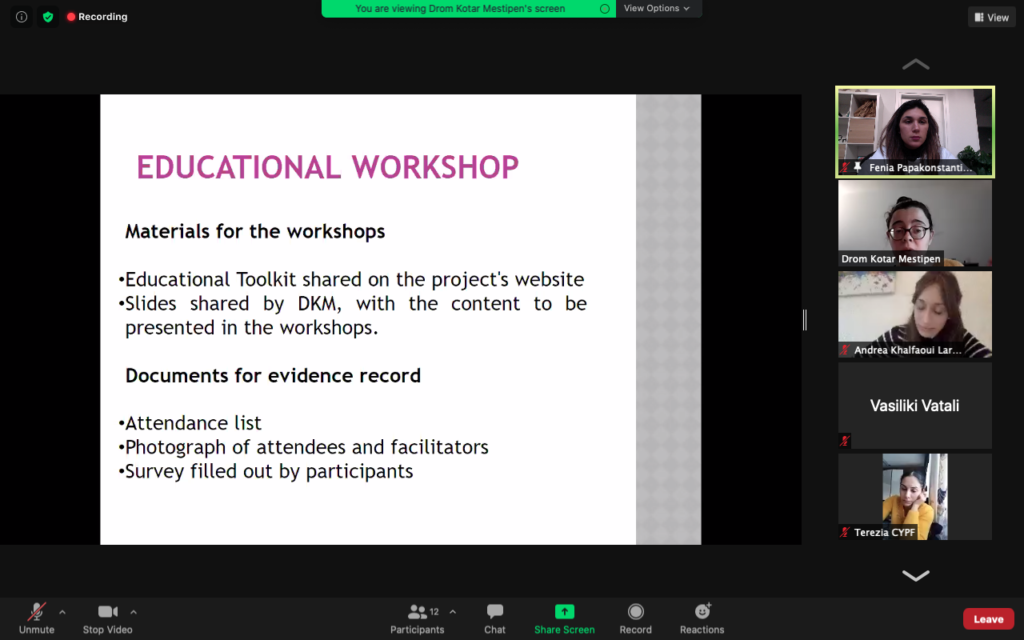
On Friday 14th of November, the Educational WorkshopMeetingthat was performed by Drom KotarMestipen and the educator Andrea Khalfaoui within the framework of the European Project RTransform.eu was successfully completed!
Staff members from the organizations from Spain, Hungary, Greece, the UK, Romania that attended the Educational Workshop, and participate in the overall project implementation, concluded the specifications for the upcoming 20 Workshops. The Workshops will be held in the next period until June 2023 by each partner organization.
The aim of these Workshops is to train adult educators, youth workers, youth organizations, and training centers and institutions, on issues relevant to successful practices in education for grassroots women and people, particularly Roma women, whereas the Workshops will pursue also to provide room for open discussions relevant to examples of Roma Women that have overcome barriers in education.
Furthermore, at the Educational Workshop, the participants had the opportunity to analyze other successful practices, examples, and role models included in the research that has already been implemented by the consortium.
Stay tuned for the progress of the project and our forthcoming actions and news! Follow the project’s social media accounts such as Facebook, Twitter, and Instagram
The online event entitled “Dialogue for Education: 1st Gathering of Greek Roma Women” was held through ZOOM, on November 20 between 16:00 and 20:00 from AID. The event was ended with smiles and success. A representative from the Municipality of Ampelokipi Menemeni, Mrs. Vatali Vasiliki has also joined the event. The aim of the event was the national gathering of Greek Roma Women in the framework of the Rtransform European Project. Roma women from all over Greece such as Thessaloniki, Serres, Corinth, Florina, Larissa, Crete, and other areas, connected and developed a concrete dialogue.
The women talked about their own history, they shared the obstacles and difficulties they faced in education, the reasons they left school early, as well as their desire to continue school. Some women also shared their motives who have found the courage and the strength to complete school education and continue into higher education by attending the university.
During the online event, Fenia Papakonstantinou explained the project, its goals, and activities, coordinated the event dialogue, and empowered Roma women to share their stories, while at the same time Rapti Ourania, a specialist in education for Roma women, referred to examples of women who continued their education.
At the second half of the event, the women were divided into groups and discussed in more detail the problems they faced in the school years, explaining the reasons why most of them left school early. Some of the reasons were the frequent mobility of their families across Greece due to seasonal jobs in different cities, the marriage obligation, starting a family from a very young age, the devotion to the family and the children’s upbringing. Moreover, the multiple obligations and symbolisms that frame the Roma Woman and her role within the Rome community. The women also discussed on taking measures that could help to overcome these difficulties and reverse obsolete habits and situations. The Gathering ended with all women emphasizing the importance of such actions and initiatives. They expressed their positive feelings towards the event as they had the opportunity to take part in the Gathering, to speak, share stories and thoughts, and have their voices heard. All the women are being committed and looking forward to the next Gathering which is expected to take place in February 2022.
Academic pathways, paths that lead to educational success
On 14 February 2002, the 1st Roma Women Student Gathering was held, organized by the Romani Association of Women Drom Kotar Mestipen, and since then this activity has been going on non-stop, even during the pandemic. On Saturday 23 October 2021, the 20th Roma Women Student Gathering of Catalonia was held at the Rovira I Virgili University in Tarragona.
Today, the event has much more importance and impact than we could have imagined when preparing the first Gathering when our objectives were to create a space for dialogue and to bring girls and women closer to positive role models. After 20 editions, we can say that it is the only event that mobilizes an average of 250 Roma women to talk about education on a Saturday afternoon and to put at the center of the debate the quality of the education that they and their children receive, to dismantle social and educational barriers, and to seek to overcome inequality due to the fact that they are Roma. We can also say that we have created a network of trust and support for girls and women who want to pursue educational success. As well as overcoming the misconceptions surrounding Roma women.
“Tell me what it takes to raise their level, but don’t take them out of class, because then they get to secondary school and they don’t have the level and that’s why they drop out.”
On Saturday we were able to talk about the possible itineraries in our current Educational System, its «traps» and its alternatives with Manuela Fernández, who is an example, for having overcome the barriers mentioned before, and also for her commitment to the Roma people, and especially to women.
At the role model table, Tatiana was able to explain to us how she is the first Roma girl to graduate from secondary school thanks to having studied at the Mediterrani Learning Community in Tarragona, encouraging other girls to overcome barriers by seeking support and help from people who work in organizations and other services.
Within the Working Groups, there was an intense debate to provide the elements to overcome educational inequality from which the Romani Association of Women will work during this year and which will be handed over to the different administrations so that they can take them into account.
On Saturday we were able to hear Roma girls and women who have studied or are studying Social Integration, Pedagogy, Medicine, Engineering, Nutrition, and Dietetics or the ESO Graduate course. All of them encouraged the other participants and were able to share how their families have been their main support, or a teacher, or an organization, but above all that being able to enjoy Successful Educational Activities and not just occurrences or entertainments is what has helped them to overcome the historical educational inequality they suffer.
Paulo Freire told us that education needs technical, scientific, and professional training as well as dreams and utopia. The volunteers and those of us who are part of the Romani Association of Women Drom Kotar Mestipen were able to feel again the rigour, strength, dreams, and illusion in Tarragona. And as Manuela Fernández said: how beautiful that it remains as beautiful as the first day without losing its validity and meaning.
This is the English translation of the article written by Montserrat Sánchez Aroca for the virtual journal “Diario Feminista”. To read the original in Spanish, please click on this link.
In order to be able to develop Successful Educational Actions in schools, following the principles that govern learning communities6, an essential aspect is the training of teachers in the scientific and theoretical bases and evidence supported by the international scientific community. It is urgent to move from the occurrences in education to the evidence of improvement of the results of those educational actions that are proposed. For training material on this topic, click the following links: information is available in English, Spanish, Greek and Maltese.
This model of conflict prevention and resolution5 is based on dialogue as a tool to overcome inequalities. In the treatment of conflict, consensus among all parties involved on the rules of coexistence takes centre stage. This generates a dialogue shared by the entire community throughout the normative process (procedural ethics). This type of model allows a qualitative improvement of coexistence both in the centres and in the whole educational community. For training material on this topic, click the following links: information is available in English, Spanish, Greek and Maltese.
It is a form of participation based on the intervention of families and other community members in the formative spaces. Community members are also included in decision making processes that involve aspects that influence the students’ learning. For training material on this topic, click the following links: information is available in English, Spanish, Greek and Maltese.
Extended learning time, as the guide on learning communities3 explains, is a form of extension of the learning time that proposes the creation of spaces beyond school hours, in which students carry out activities accompanied by volunteers (teachers, family members and other community members). For training material on this topic, click the following links: information is available in English, Spanish, Greek and Maltese.
Family education consists, according to the INLCUD-ED guide4, of involving families and other members of the community in various learning activities at school. The learning activities can be very diverse, the only condition is that they are defined (content, organization and timing) by the participants themselves to ensure that the program responds directly to their needs and interests, and that they follow a dialogic orientation. Family education is based on previous theories and research that have already shown that fostering cultural and educational interactions between students and social agents, and more specifically with family members, improves student performance.
For training material on this topic, click the following links: information is available in English, Spanish, Greek and Maltese. Module 1 and 9
The dialogic literary gatherings (DLG) are one of the successful educational actions identified in the INCLUD-ED2 research project. DLGs are used to improve the education of children and young people in different contexts around the world. DLGs are a dialogic reading activity based on two principles: a piece of classical literature is read (such as Romeo and Juliet, the Odyssey, Don Quixote) and then meanings, interpretations and reflections are shared with a dialogic learning methodology
For training material on this topic, click the following links: information is available in English, Spanish, Greek and Maltese.
As it is established in the INCLUD-ED1 guide, interactive groups consist of grouping the students of a class into small heterogeneous groups, with the support of an adult in each one of them. Each of these groups is organized around four or five students, heterogeneously in terms of level, competence, gender, culture, language, and ethnicity. In the learning processes of the IG, there are two profiles of adults: teachers and volunteers. Volunteers are usually family members and members of the community, which may be illiterate people or people with very low educational levels, old students, college students and other adults belonging to community organizations. For training material on this topic, click the following links: information is available in English, Spanish, Greek and Maltese.
We use cookies on our website to give you the most relevant experience by remembering your preferences and repeat visits. By clicking “Accept”, you consent to the use of ALL the cookies.
This website uses cookies to improve your experience while you navigate through the website. Out of these, the cookies that are categorized as necessary are stored on your browser as they are essential for the working of basic functionalities of the website. We also use third-party cookies that help us analyze and understand how you use this website. These cookies will be stored in your browser only with your consent. You also have the option to opt-out of these cookies. But opting out of some of these cookies may affect your browsing experience.
Necessary cookies are absolutely essential for the website to function properly. These cookies ensure basic functionalities and security features of the website, anonymously.
Cookie
Duración
Descripción
cookielawinfo-checbox-analytics
11 months
This cookie is set by GDPR Cookie Consent plugin. The cookie is used to store the user consent for the cookies in the category "Analytics".
cookielawinfo-checbox-functional
11 months
The cookie is set by GDPR cookie consent to record the user consent for the cookies in the category "Functional".
cookielawinfo-checbox-others
11 months
This cookie is set by GDPR Cookie Consent plugin. The cookie is used to store the user consent for the cookies in the category "Other.
cookielawinfo-checkbox-necessary
11 months
This cookie is set by GDPR Cookie Consent plugin. The cookies is used to store the user consent for the cookies in the category "Necessary".
cookielawinfo-checkbox-performance
11 months
This cookie is set by GDPR Cookie Consent plugin. The cookie is used to store the user consent for the cookies in the category "Performance".
viewed_cookie_policy
11 months
The cookie is set by the GDPR Cookie Consent plugin and is used to store whether or not user has consented to the use of cookies. It does not store any personal data.
Functional cookies help to perform certain functionalities like sharing the content of the website on social media platforms, collect feedbacks, and other third-party features.
Performance cookies are used to understand and analyze the key performance indexes of the website which helps in delivering a better user experience for the visitors.
Analytical cookies are used to understand how visitors interact with the website. These cookies help provide information on metrics the number of visitors, bounce rate, traffic source, etc.
Advertisement cookies are used to provide visitors with relevant ads and marketing campaigns. These cookies track visitors across websites and collect information to provide customized ads.
 English
 Bulgarian
 Greek
Greek Hungarian
 Spanish